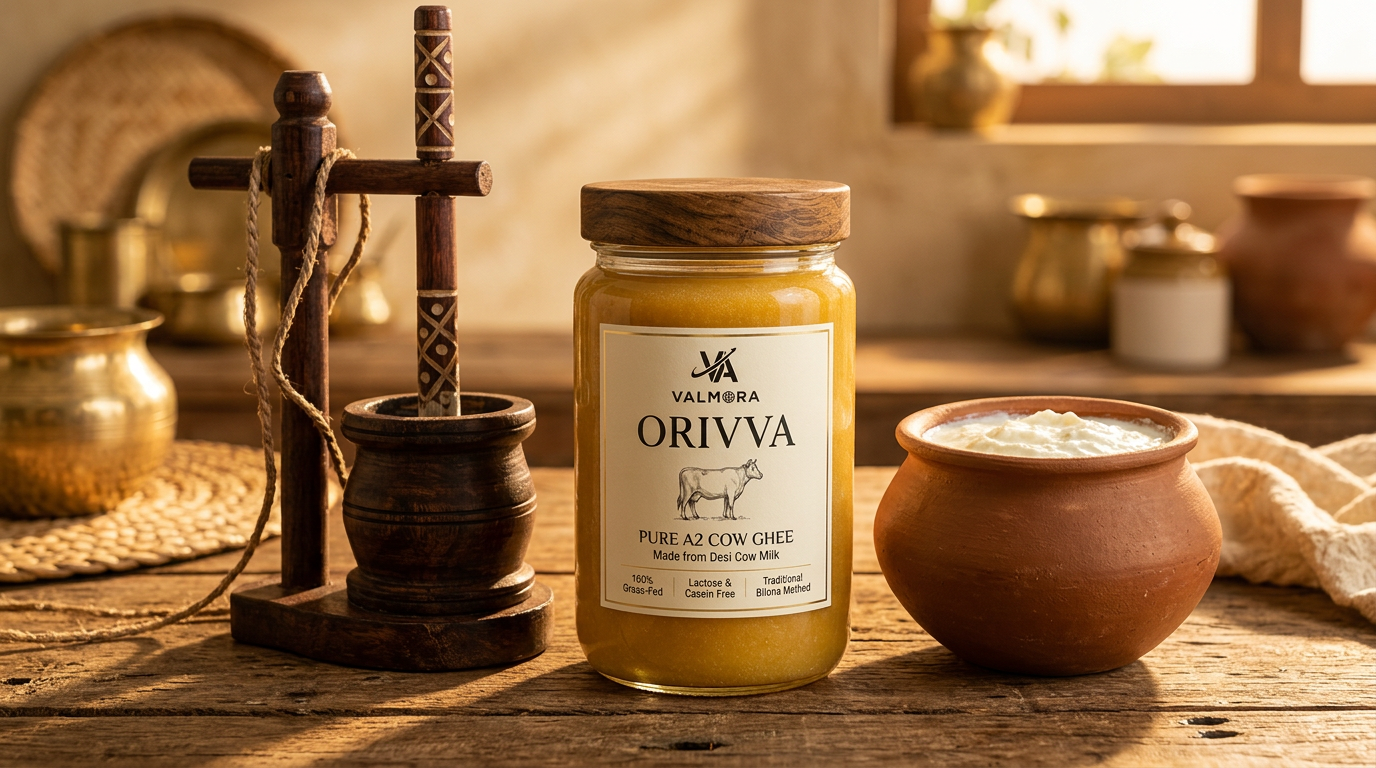
The Bilona Method: How Traditional Indian Ghee Is Really Made
If you've ever opened a jar of ghee and thought it tasted like nothing in particular, you've probably had commercial ghee. If you've ever opened a jar and stopped because the aroma was so nutty, so deep, so distinctly different, you've likely had ghee made the bilona way.
The bilona method is the traditional Indian process for making ghee, used for centuries before factories existed. It's slow, it's labour-intensive, and it produces a product that doesn't really compare to anything mass-produced. Here's what it actually involves and why Australian buyers are increasingly seeking it out.
What "bilona" actually means
Bilona is a Hindi word for the wooden churn used to separate butter from curd. In its purest form, the bilona method ghee process follows a specific sequence that has barely changed in thousands of years.
Step 1: Milk. Milk is collected from cows, traditionally Indian native breeds like Gir, Sahiwal, or Tharparkar.
Step 2: Boil and cool. The milk is boiled, then cooled to body temperature.
Step 3: Set the curd. A small amount of yoghurt culture is added and the milk is left overnight to set into thick curd (dahi).
Step 4: Churn. The curd is churned, traditionally by hand using a wooden bilona, until the butter separates and rises to the top. This part takes 30 minutes or more per batch.
Step 5: Collect the butter. The white butter (makhan) is collected, and the buttermilk (chaas) is set aside.
Step 6: Simmer to ghee. The butter is melted in a heavy-bottomed pot and simmered slowly over a low flame. The water evaporates, the milk solids settle and brown, and the fat clarifies.
Step 7: Filter and store. The clear golden ghee is strained through muslin and stored in glass.
No shortcuts, no industrial equipment.
How it's different from regular factory ghee
Most ghee sold globally, including most "desi ghee" on Australian shelves, is made by a faster industrial method: milk is sent to a factory, made into cream, churned directly into butter without the curd step, then clarified and packaged.
A factory can produce thousands of kilos in the time it takes to make a few kilos by hand. The chemistry is similar but the flavour profile is noticeably different. Skipping the curd step removes a layer of fermentation that contributes complexity, slight tang, and aroma compounds to the final product.
Industrial ghee tastes cleaner and more neutral. Bilona ghee tastes deeper, nuttier, and more "alive."
Why it actually tastes different
1. Fermentation. The curd-setting step introduces lactic acid bacteria, which alter the milk's chemistry.
2. Slow simmering. Industrial ghee is often clarified quickly at higher temperatures. Bilona ghee simmers slowly, which allows the milk solids to caramelise gently.
3. Source milk. Most bilona ghee uses indigenous cow breeds raised traditionally, which produce richer milk than commercial dairy breeds.
These three factors compound. None alone makes the difference, but together they create a product that's clearly distinct.
Why it costs more
• It takes 25 to 30 litres of milk to make 1 kg of ghee• The curd step adds 8 to 12 hours of setting time• Manual churning takes labour• Slow simmering uses more fuel per kilo• Small-batch production means no factory economies of scale
Add traceable A2 cow milk to that, and you understand why genuine bilona ghee in Australia retails between $55 and $90 per kilo. You're not paying for marketing. You're paying for time, milk volume, and labour.
How to tell if your ghee is actually bilona-made
Clear process description on the label or website. Real producers explain their process: curd-setting, hand-churning, slow simmering.
Breed traceability. Most authentic bilona producers work with Indian native breeds and will name them.
Small batch numbers. Real bilona production is small-scale.
Texture and aroma. Genuine bilona ghee has a distinctly grainy texture when solid (micro-crystals of fat that form during slow cooling) and a strong, complex aroma when warm.
Colour variation by season. Cow's diet changes with the seasons, and bilona ghee from grass-fed cows shows slight colour variation through the year.
Who should buy bilona ghee?
Bilona ghee is worth the extra cost if you use ghee as a finishing fat (on dal, khichdi, rice, toast), you're particularly interested in traditional pure desi ghee for ayurvedic or religious purposes, you appreciate small-batch artisan food, or you have mild dairy sensitivities and want the most carefully filtered product.
It's probably not necessary if you're using ghee mostly for high-heat frying, you're new to ghee, or budget is tight and you cook daily with ghee.
The bilona method outside India
A few small Australian dairies have started experimenting with the bilona method using local A2 cows. The product is fresh and the dairy is closer to home, but the flavour can differ from Indian bilona ghee. Indian native breeds, the climate, the fodder, and the traditional culture all play a role.
FAQs
Is bilona ghee the same as A2 ghee? Not exactly. Bilona refers to the process. A2 refers to the milk protein type. Many premium ghee products are both, but you can have one without the other.
Why is bilona ghee grainy? The grainy texture comes from micro-crystals of butter fat that form when ghee cools slowly. It's a sign of quality.
Does bilona ghee have more nutrients? The fat and vitamin content is similar to other ghee. The flavour difference is the main distinction.
Is bilona ghee available in Australia? Yes, though selection is limited. A handful of specialist Indian importers and a small number of Australian dairies now offer genuine bilona ghee.