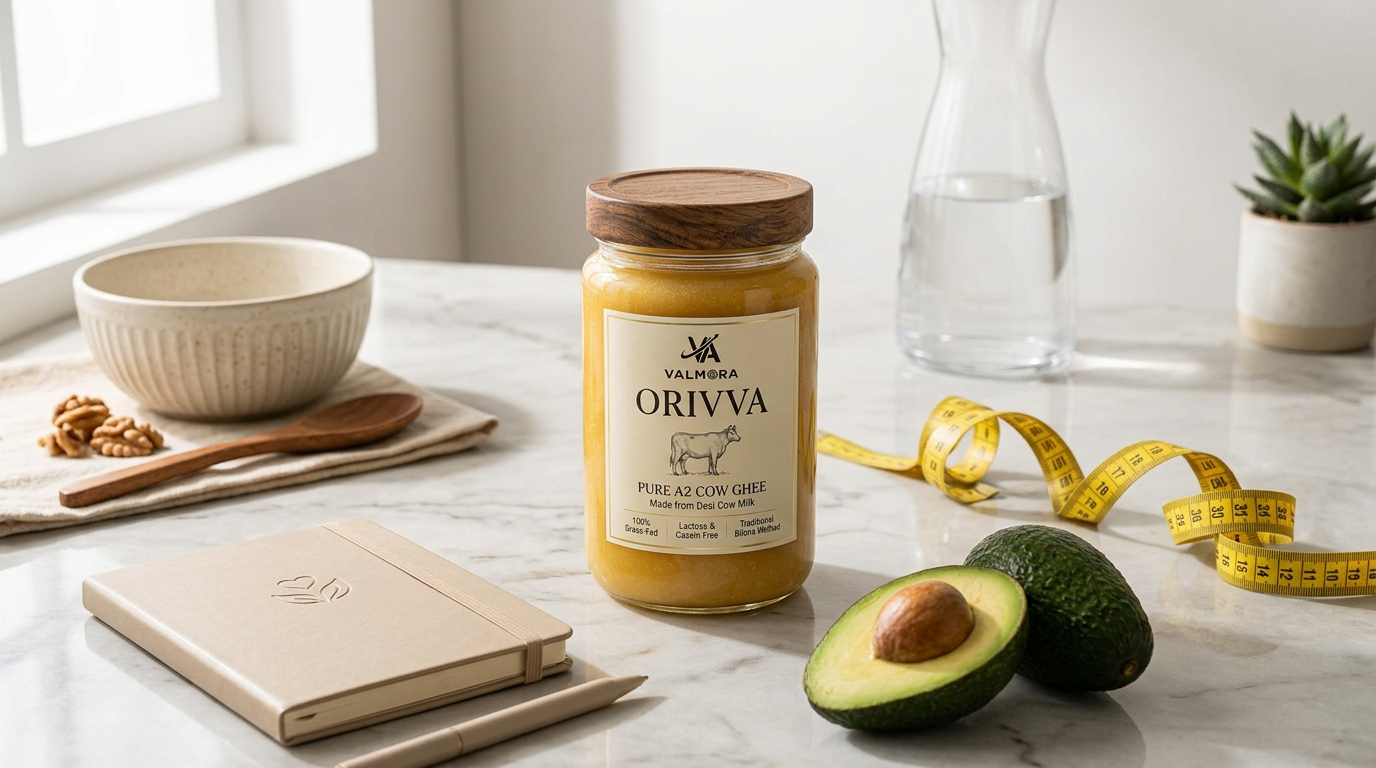
Is Ghee Keto, Lactose-Free, and Better Than Butter? Honest Answer
Ghee gets a lot of credit it doesn't quite deserve, and a lot of dismissal it doesn't quite deserve either. Walk into a health food shop in Bondi or Fitzroy and you'll hear it called a superfood. Walk into a doctor's surgery and you might hear "it's just clarified butter, calm down."
The truth sits in between. Here's an honest look at the real ghee health benefits, whether it actually fits keto, whether it's safe for the lactose intolerant, and how it really compares to butter.
Is ghee keto-friendly?
Short answer: yes, ghee is one of the best fats for a ketogenic diet.
Ghee is essentially pure fat. It contains roughly 99 percent fat, zero carbohydrates, almost no protein, and around 9 calories per gram. On keto, where the macro target is typically 70 to 75 percent fat, 20 to 25 percent protein, and under 50 g carbs per day, ghee fits perfectly.
The only watch-out is portion size. Ghee is calorie-dense at around 120 calories per tablespoon.
Is ghee actually lactose-free?
Mostly yes, with a small caveat.
When ghee is made properly, the milk fat is heated until the water evaporates and the milk solids (which contain lactose and casein) separate and are filtered out. What's left is the pure fat. Food Standards Australia New Zealand confirms that ghee contains negligible lactose. Most studies put the residual lactose at under 0.5 percent.
The caveat: not all ghee is filtered to the same standard. If you're severely lactose intolerant, look for ghee labelled "lactose-free" or made by reputable producers.
If you have a clinical dairy or casein allergy (rather than intolerance), trace casein could still trigger an allergic reaction. Consult your GP or allergist before adding ghee to your diet.
Is ghee better than butter?
For cooking at high heat: yes, clearly. Ghee has a smoke point of around 250°C compared to butter's 150°C. For frying, searing, or roasting, ghee is the cleaner choice.
For dairy sensitivity: yes. Ghee removes the components of butter that cause issues for most lactose-intolerant people.
For shelf life: yes. Ghee keeps at room temperature for months. Butter needs refrigeration.
For everyday saturated fat content: not really. Ghee is roughly 60 to 65 percent saturated fat; butter is around 50 percent. If saturated fat is a concern in your diet, ghee is not "better" than butter.
For vitamin content: Both are good sources of fat-soluble vitamins (A, D, E, K). Ghee tends to be slightly more concentrated.
For flavour in cold use (on toast, in baking): Subjective. Butter has a fresh, creamy taste. Ghee has a deeper, nuttier flavour.
What ghee actually does that's worth knowing
Strip away the marketing claims and the real, evidence-supported ghee health benefits are:
1. High smoke point makes it safer for frying. Less oxidation, fewer harmful compounds at high heat.
2. Tolerated by most lactose-intolerant people. The clarification process removes the components that cause digestive issues.
3. Source of butyric acid. A short-chain fatty acid that some research links to gut health.
4. Fat-soluble vitamins. Real grass-fed cow ghee is a meaningful source of vitamin A and vitamin K2.
5. Stable for storage. Long shelf life, no refrigeration needed, less food waste.
What ghee doesn't do
• It doesn't melt belly fat or cause weight loss on its own• It doesn't cure inflammation• It doesn't replace medical treatment for any condition• Eating large amounts daily isn't necessarily better than small amounts
Ghee is a good cooking fat with a few genuine nutritional advantages. It is not a medicine.
Where it fits in your diet
The Heart Foundation of Australia and most mainstream dietary guidelines still recommend limiting saturated fat to around 10 percent of daily calories. For most adults, that's roughly 20 to 22 g of saturated fat per day.
One tablespoon of ghee contains about 8 to 9 g of saturated fat. So ghee fits comfortably into a balanced diet at one to two tablespoons a day for cooking.
If you have high cholesterol, established heart disease, or family history, talk to your GP before making ghee a daily staple.
The honest verdict
Ghee is:• Keto-friendly: yes, confidently• Lactose-free for practical purposes: yes, for most people• Better than butter for high-heat cooking: yes• A health miracle: no• Worth adding to a balanced diet: in moderation, yes
FAQs
How much ghee per day is safe? For most adults, one to two tablespoons a day fits within Heart Foundation saturated fat guidelines.
Is ghee good for weight loss? Not directly. It's calorie-dense. Replacing seed oils with ghee for cooking can be part of a sensible diet, particularly on lower-carb plans.
Can people with high cholesterol eat ghee? Talk to your GP. Saturated fat intake matters for cholesterol management.
Is ghee suitable for dairy allergies? For lactose intolerance, usually yes. For clinical dairy or casein allergies, not necessarily. Always check with an allergist.